
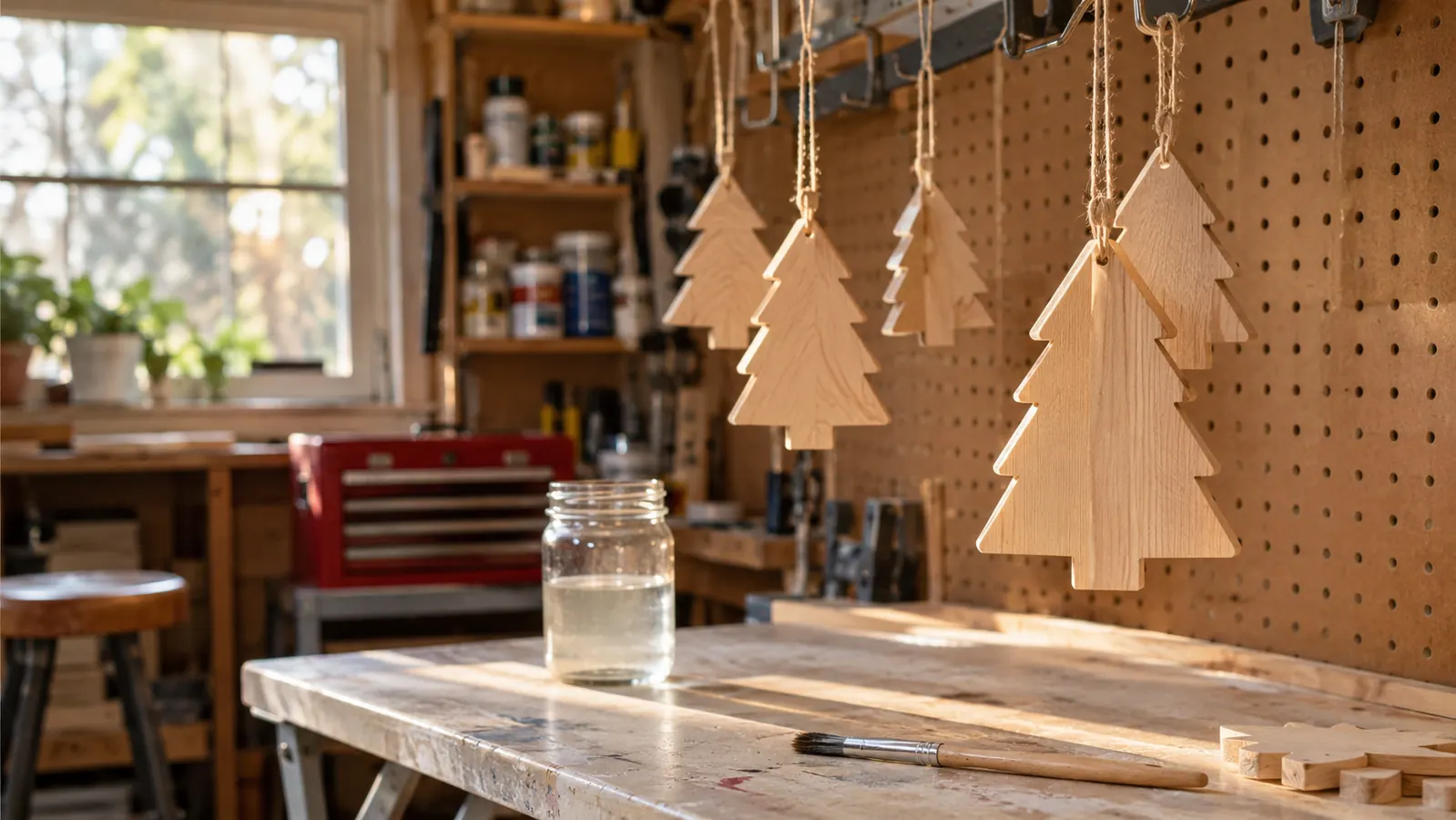
Every December I tell myself I am done buying ornament blanks, and every January I am back at the workbench sanding the edges of a new batch anyway. The trouble with most unfinished wooden ornaments is that they look fine in the listing photo and then arrive too thin to hold a decent layer of paint, or warped, or split along the grain the first time you put a hook through them. I bought the N&T NIETING 27-piece set of 4-inch wooden tree ornaments about fourteen months ago, and after two craft fair seasons, a lot of paint, and one very full Christmas tree, they are still the blanks I reach for first.
These are not fancy ornaments. They are plain unfinished wooden trees, twenty-seven of them, in nine different styles with three of each. That plainness is the whole point. A blank that lets you do the work is worth more than a decorated ornament you cannot change, and after a year of real use I have a clear picture of what this set does well and where it comes up short. I have kept notes on the ones I painted, the ones I gave away, and the ones that came back from the fair unsold, because that is the only honest way to review a blank.
The Quick Verdict
A consistent, well-cut unfinished tree ornament that takes paint, stain, and engraving without complaint. Not the thickest blank I have used, but the nine-style variety and clean edges make it easy to build a whole tree full of decorations.
Amazon Check Today's Price →If you finish your own ornaments, these are the blanks to start with
Twenty-seven wooden trees in nine styles, three of each, with twine included for hanging. After two seasons in my workshop, they have earned a permanent spot on the shelf.
Amazon Check Today's Price on Amazon →How I've Used It
I ordered the set in early October last year, which turned out to be good timing because October is when I start testing blanks for the December craft fairs. The box is plain, a simple cardboard carton, and all twenty-seven trees from N&T NIETING arrived intact, which is more than I can say for some blanks I have ordered. I sorted them on the folding work table, kept one of each style for our own tree, and set the rest aside as test pieces.
Over the next fourteen months those test pieces went through just about everything a blank can go through. Some got two coats of acrylic paint and a layer of sealer. Some got engraved with names and years. A dozen went to the craft fair table, where strangers picked them up, turned them over, and put them back. The last few hung on our tree for the whole season, then went into a plastic bin in the garage until this fall. I wrote the date on the bottom of one tree in pencil, the way you date a test cut, so I would know exactly how long the set had been in service.
The set has also survived my worst habit, which is buying blanks, painting two, and letting the rest sit in a drawer. I did not do that with these. The variety helped. Nine styles is enough that I could group them by project instead of staring at a stack of identical trees.

Nine Styles, Three of Each
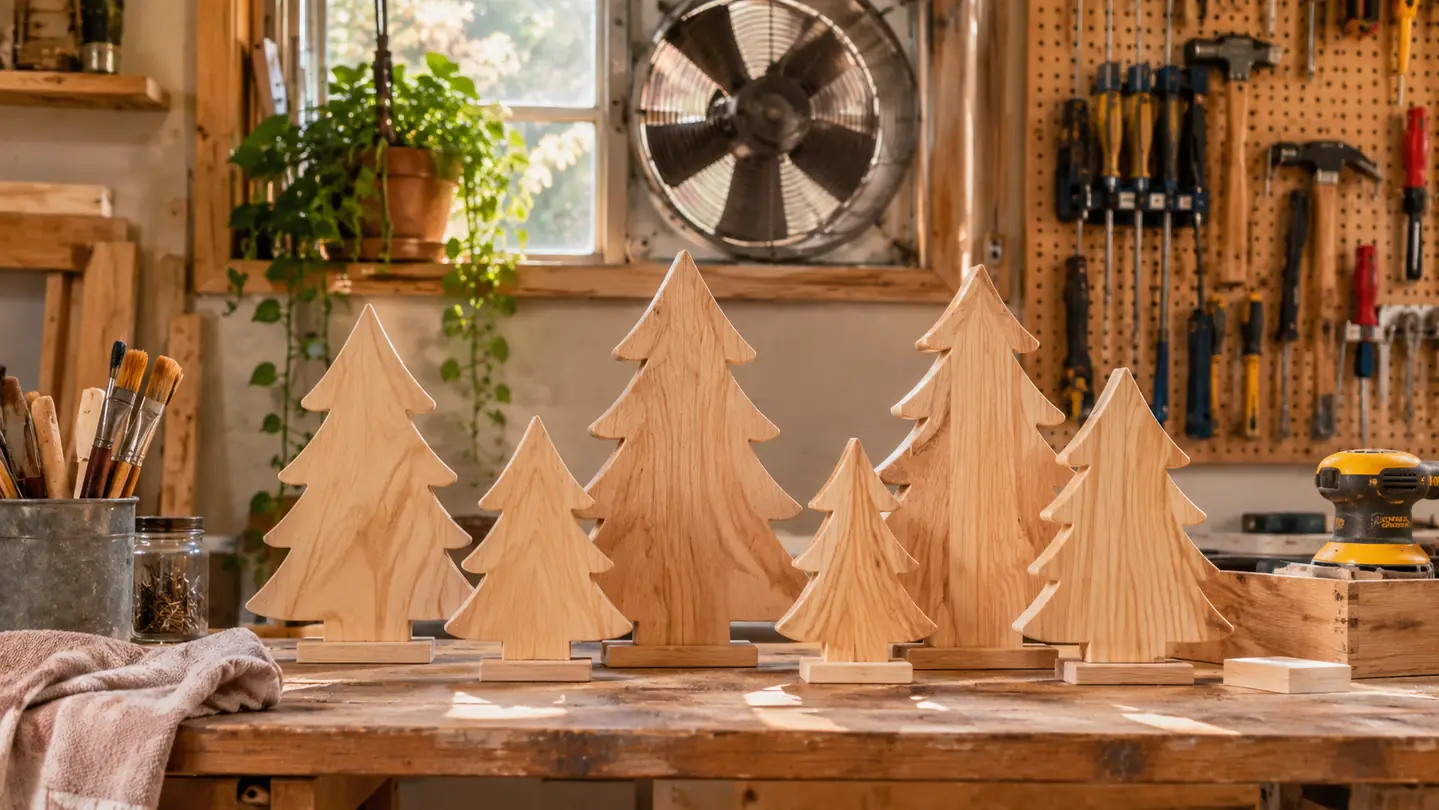
Most ornament blank sets give you one shape repeated. This one gives nine distinct tree silhouettes, and the differences are not just decorative. A few styles are tall and narrow, a few are wide with a chunky base, and a couple have branches cut deep enough that you can see light between them. The differences show up most clearly before you paint, when the raw silhouettes are all you have to look at. The style is rustic, plain and honest, which is what I wanted for a farmhouse mantel. When you paint a dozen and line them up, the variety reads as intentional, like a real tree full of different ornaments instead of the same tree repeated.
Each tree measures about four inches tall, which is a good size for a mantel, a small tree, or a wreath. They are cut from natural wood, and the cut edges are clean enough that I did not have to sand away scorch marks on most of them. The listing from N&T NIETING describes them as laser made, and the edge quality matches that description. A twine rope comes with each tree, so you do not need to buy hanging cord separately. The four-inch height holds across the set, which matters when you are grouping them on a single wreath.
The three-of-each arrangement matters more than it sounds like. If you are making gifts, three identical trees is exactly the number you want for a set of three siblings or three coworkers. If you are stocking a fair table, it means you can paint one style three different ways and compare them before you commit to a full batch.
How They Take Paint, Stain, and Ink
Unfinished wood is a gamble. Some blanks drink the first coat of paint and leave you with a rough, fuzzy surface. These do not. The faces are smooth, and acrylic paint goes on evenly with a brush or a sponge. Two thin coats give a solid finish, and a third is only needed if you are covering the whole surface in a light color.
I have also tried stain on a few of them. A light walnut stain brings out the grain without darkening the cut edges too much, and it dries fast enough that I can seal the same afternoon. For engraving, the surface takes a clean line without much fuss. I engraved names and years on six of them for gifts, and none of the lettering bled or charred wider than the cut.
For sealing, a spray sealer is the fastest route and it does not disturb the paint. I have also brushed a matte sealer onto the engraved pieces, and it dries clear without yellowing the wood. Both approaches have held up through a full season on the tree, which is the test that matters.
The one thing I would warn about is the back face. It is smooth, but it is also the face nobody looks at once the ornament hangs, so I stopped finishing it. That is not a flaw in the blank. It is just a place to save time, and it tells you the front face is the one they paid attention to when they cut these.
Fourteen Months of Storage and Hanging
Here is the part that matters if you are buying these to make things you intend to keep or sell. After fourteen months, two fair seasons, and a full Christmas on our tree, I have had exactly one break, and it was my fault. I dropped a painted tree onto the concrete floor of the garage and it cracked along the grain. The rest came out of storage this fall with no warping, no splits, and no loose twine.
Storage was not gentle. The ornaments went into a plastic bin with the rest of the holiday stock, stacked on top of each other, and sat in an unheated garage through a Tennessee summer. Heat and humidity are what warp thin wood, and these stayed flat. The twine, which I half expected to stretch or rot, is still tight on every piece.
They also hang well. The trees hang straight rather than tilting forward, which sounds like a small thing until you have hung a hundred ornaments that face the wall. Once they are on the tree, the four-inch size reads clearly from across the room, and the unfinished wood catches the tree lights without competing with them. I have also hung a few on the wreath by the front door, where they get wind and weather, and they have held up there too.
What I Made With a Box of Twenty-Seven
The clearest test of a blank is what you actually make with it, so here is where the box went. Twelve trees became painted ornaments for the fair table, in three color groups of four, and nine of the twelve sold. The color groups were a simple way to make the fair table look deliberate: four in reds, four in greens, and four finished with just a sealer so the natural wood showed. Six became engraved name ornaments, including one for Josie's tree in Asheville and one for our own mantel. Four went on our tree in the styles I liked best. The rest are still in the bin, waiting for the next project.
The engraved ones are the ones I would point to if you are on the fence. A four-inch wooden tree is the right size for a name and a year, and the finished piece looks like something you would pay for at a holiday market rather than something you made in a garage. I gave the last one to a neighbor, and she asked where I bought it before I told her I made it.
One more use I did not expect: they make good gift tags. Write a name on the front, tie the twine around the package, and the tag becomes a keepsake. I did that for a few neighbor gifts last year, and two neighbors mentioned the tree tags were still hanging on their kitchen cabinets in March.
Where the Set Falls Short
I want to be straight about the limits. Four inches is on the smaller side, so if you decorate a large tree or like ornaments that make a statement, these will read as accents rather than centerpieces. The wood is also not thick. It is sturdy enough for normal use, but it is a flat cutout, not a chunky plaque, and it will not survive being sat on or crushed in a full box.
The nine styles are all trees. If you want a set that mixes snowmen, stars, and angels, this is not that set. The variety is within one shape, which is exactly what the listing promises, but it is worth saying plainly so you are not surprised when the box arrives.
And because the surface is unfinished, these are not ornaments you can hang the day they arrive. They need paint or sealer before they look finished. For a crafter that is the appeal. For someone who just wants to decorate, it is homework. That is the tradeoff you are signing up for, and it is the reason I would not hand this set to someone who does not like doing the work.
What I Liked
- Nine different tree styles, three of each, so you can group by project or compare finishes
- Clean laser-cut edges that take paint, stain, and engraving without much prep
- Twine included with every tree, no separate cord to buy
- Stayed flat and split-free through a year of unheated garage storage
- Four-inch size works for trees, wreaths, garlands, and gift tags
Where It Falls Short
- Four inches is small for a large tree
- All nine styles are trees, no other shapes
- Flat cutout, not a thick plaque, so it can crack if dropped on concrete
- Unfinished surface means you must paint or seal before hanging
After fourteen months, two fair seasons, and a full Christmas on our tree, I have had exactly one break, and it was my fault.
Who This Is For
Buy these if you paint, stain, or engrave your own ornaments and you want a blank that behaves. If you sell at craft fairs, the nine-style variety means you can offer a range of looks without buying nine separate packs. If you make family gifts, the four-inch size is easy to personalize with a name and a year, and the surface takes paint, marker, or pen. If you are new to finishing wood, these are forgiving: the edges are clean, the faces are smooth, and a mistake costs you one of twenty-seven trees instead of an afternoon of work. If you are the kind of person who keeps a pegboard of sanding blocks and a shelf of half-finished projects, you already know whether you want these. The answer is probably yes.
Who Should Skip It
Skip these if you want ornaments you can hang straight out of the box. There is no finish on them, so they will look bare until you do the work. Skip them if you decorate a very large tree and want ornaments with more visual weight. Four inches of unfinished wood will disappear in the branches. And if you are shopping for a gift for someone who does not craft, a finished ornament is the better choice. There is no shame in that. I buy finished ornaments every year for people who would never finish a blank, and they are happier for it. This set from N&T NIETING is for people who like the doing.
The set I keep coming back to, season after season
Twenty-seven wooden trees in nine styles, three of each, with twine included. If you finish your own ornaments, this is the blank to have on the shelf.
Amazon Check Today's Price on Amazon →